Category Archives: What We Do

Paambu Kadi Maranam Illa Kovaiyai Uruvakkalam – Creating a Snakebite-Free Coimbatore and Tamil Nadu.

Intro

Through awareness, education and safe rescue practices, WNCT’s Snakebite-Free Campaign hopes to transform Coimbatore, the Nilgiris and Tamil Nadu. 

Our Journey So Far…

For over a decade, WNCT has been dedicated to wildlife and nature conservation, with early snake awareness efforts dating back to 2012 under the leadership of its founder, Mr.Sadiq Ali.

Our initial focus was on snake rescues, understanding their behaviour, and promoting safe handling practices. Over time, this evolved into a community-wide mission to reduce fear, promote awareness, and build coexistence between people and snakes.

Human Animal conflict 

In the past three years, we’ve intensified our work in response to the sharp rise in snakebite incidents and preventable deaths in Coimbatore and the Nilgiris.

When people think of human–wildlife conflict, elephants, tigers, or leopards often come to mind.
In reality, snakes are responsible for the highest number of human deaths in such encounters.

Backed by a team of trained rescuers, educators, and volunteers with years of field experience, WNCT channelled its collective expertise into a focused strategy to reduce snakebite-related deaths in the region.

The Real Threat 

We realised that the biggest danger isn’t snakes themselves, but the lack of awareness and delay in seeking proper treatment.
This realisation gave birth to our campaign:

A Snakebite-Free Coimbatore and Tamil Nadu – Paambu Kadi Maranam Illa Kovaiyai Uruvakkalam.

The campaign’s twin goals are:

  • Saving human lives, and
  • Safely releasing snakes into suitable habitats when found in human-inhabited spaces.

Why Snakes Matter

Snakes are key indicators of a healthy ecosystem and nature’s most effective pest controllers, keeping rodent populations in check — pests that destroy crops and spread diseases.

Protecting snakes protects the balance of our environment.

Our Awareness Efforts

To reach every section of society, we designed campaigns targeting:

  • Schools and colleges
  • Tribal communities and farmers
  • Corporate organisations and the general public

So far, we’ve conducted over 200 awareness programs and classes on nature and wildlife conservation, focusing on:

  • Demystifying the “Big Four” venomous snakes
  • Identifying venomous vs. non-venomous species
  • Understanding what to do when a snake is sighted
  • Following correct post-bite protocols, including immediate hospitalisation

The Impact 

Our combined efforts have led to a visible shift in community behaviour.

  • There’s been a surge in rescue and identification calls
  • People are choosing coexistence over conflict
  • Communities are increasingly alerting trained rescuers rather than resorting to fear-driven actions

Encouraging Trends from CMCH

Data from the Coimbatore Medical College Hospital (CMCH) shows promising improvement:

  • 2022: 976 patients treated | 40 deaths
  • 2023: 40 deaths
  • 2024 (Jan–Oct): 662 cases | 20 deaths

While multiple factors contribute to this improvement — including quicker medical response, community awareness, and ongoing public health initiatives — these positive trends align closely with the period of WNCT’s intensified outreach and education efforts.

Beyond statistics, the cultural change is unmistakable. The community now reaches out for safe identification and rescue instead of reacting with fear.

A Milestone Moment

On World Snake Day 2025, Honourable District Collector, Mr.Pavankumar G. Giriyappanavar released our comprehensive guide:
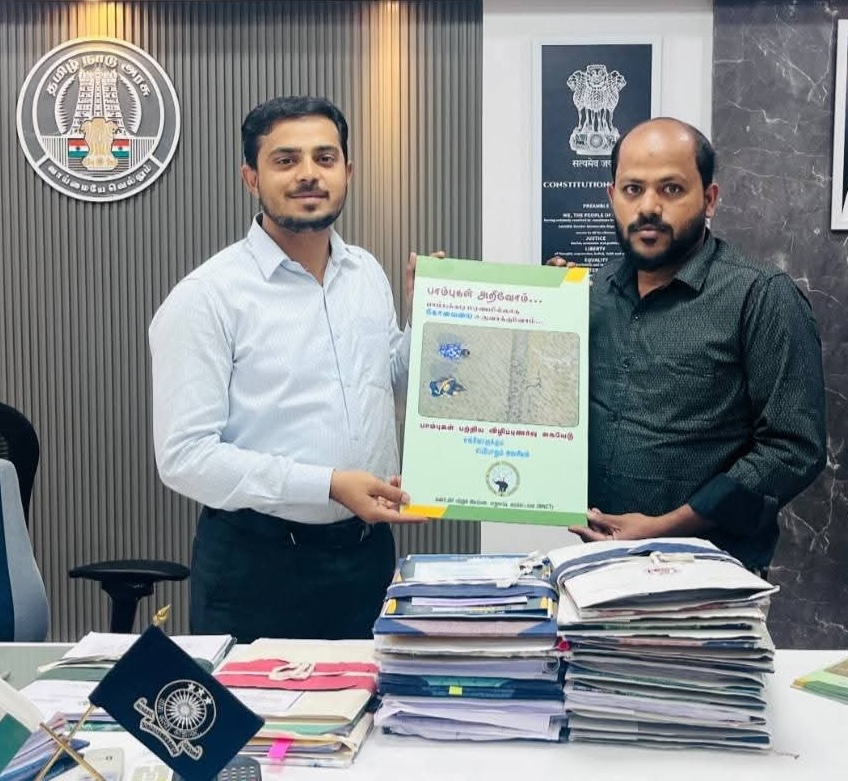
Our WNCT Coordinator Mr.Sirajdeen with our Honourable District Collector, Mr.PavanKumar G. Giriyappanavar

“Paambugalai Arivom, Paambu Kadi Maranam Illa Kovaiyai Uruvakkalam”
(Knowing Snakes and Making Coimbatore Snakebite-Free)

Created by WNCT Coordinator Sirajdeen, this simplified handbook translates complex information on snake identification and life-saving first-aid steps into an easy-to-understand format.

In partnership with the Coimbatore Collectorate, WNCT continues to distribute this guide widely, ensuring that the path toward a snakebite-free Coimbatore is clear, inclusive, and community-driven.

Quote

“Saving lives begins with awareness. Every citizen can play a part in creating a snakebite-free Coimbatore.”
Sadiq Ali, Founder, WNCT

Get Involved

Want to organise an awareness session in your community, school, or workplace?
Email us at info@wnct.in

Need Wildlife Rescue Help?
📞 Call the Tamil Nadu Forest Department at 1800 4254 5456

In Case of a Snakebite Emergency:
Proceed immediately to the nearest government hospital such as CMCH or GH Mettupalayam, both equipped with anti-venom and trained staff.

Local Snake Rescues:
Reach out to the WNCT team via +91-96550 23288, which works with a trained network of rescuers in coordination with the Tamil Nadu Forest Department for safe handling and relocation.
Suggestions / FAQ

Nvk Ashraf – Aug 29th, 8:42pm

Well, why was the word “matanga” a Sanskrit word used, when there are more than 100 words in Tamil to choose from?

Vikraman Narasimhan Aug 29th, 1:24am

Hello, I would like to know more about the organization and interested in joining as well. Kindly direct me to proper resource

Tribes

Tribes of South India

Tamilnadu – Todas, Irulas, Kurumbas, Kotas, Kurumans, Kadars, Kattunaikas, Muthuvans, Paniyans, Pulayans, Malayalees, Eravallans, Kanikkars, Mannans, Paliyans.

Kerala – Malakuravans, Malayarayans, Malavetans, Malayans, Mannans, Ullatans, Uralis, Vishawans, Arandans, Kattunaykans, Koragas, Kotas, Kurichiyans, Kurumans, Paniyas, Pulayans, Malsars and Kurumbas.

Karnataka – Gaudalus, Hakkipikkis, Irruligas, Jenu Kurubas, Malaikuds, Malikudis, Bhils, Gonds, Chenchus, Koyas, Yeravas, Haleyas and Koramas.

AndhraPradesh – Chenchus, Koyas, Gadabas, Konda, Doras, Konda Kapur, Konda Reddis, Sugalis/Lambadis, Yenadis, Yerukulas, Bhils, Gonds, Kolams, Pradhans & Valmikis.

Pondichery – Irulas, Kattunaikers, Kurumans, Zipsis.

Threatened / Endangered Species

Wildlife extinction threatens human life.

The IUCN Red List of Threatened Species report shows that “of the 63,837 species assessed, 19,817 are threatened with extinction, including 41% of amphibians, 33% of reef building corals, 25% of mammals, 13% of birds, and 30% of conifers.”

The IUCN Red List is a well-respected marker of the health of the world’s biodiversity.

“Sustainability is a matter of life and death for people on the planet,” says Julia Marton-Lefèvre, Director General, IUCN (International Union for Conservation of Nature). “A sustainable future cannot be achieved without conserving biological diversity — animal and plant species, their habitats and their genes — not only for nature itself, but also for all 7 billion people who depend on it.

The Red list of threatened species, has listed 132 species of plants and animals as Critically Endangered, the most threatened category from India.  Plants seemed to be the most threatened life form with 60 species being listed as critically endangered and 141 as endangered.

The critically endangered list included 18 species of amphibians, 14 fishes, and 10 mammals.  There are also 15 bird species in the category.

The IUCN Red List is a clarion call to world leaders to secure the web of life on this planet.

Invasive / Exotic Species

Forests play a vital role in nation’s economy. They provide tangible as well as intangible benefits. The tangible benefits include providing fuel wood, timber, non-timber forest products like bamboos, lac, gum, resin, katha, medicinal plants and raw materials for wood based industries like paper, pulp, plywood etc. They also provide materials for defence and communications as well as grazing for cattle. The intangible benefits include conservation of soil fertility and play an important role in the maintenance of the water regime of the land. The forests provide water, perhaps the most important forest product. The organic matter which they yield improves the fertility and increase the water holding capacity of the soil thereby reducing the run-off. The presence of vegetation acts as a physical check to the velocity of the run-off and reduces its soil carrying capacity. Thus forests protect the hilly areas against excessive soil erosion. Similarly, they protect flat lands against desiccation and erosion caused by winds. They exert a beneficial influence on the growth of agricultural crops and on the climate of the region in which they exist. The forests of India are endowed with rich flora and fauna. There are about 45,000 plant species in India which is 12% of the global plant wealth. The animal species are approximately 81,250. There are 92 National Parks and 500 Wildlife Sanctuaries in India. The total extent of protected areas include five designated World Heritage Sites, fourteen Biosphere Reserves, six Ramsar Sites, twenty eight (37761 square km) Project Tiger Reserves and nine Elephant Reserves.

The introduction of non-indigenous alien, invasive, or exotic species to an area has disrupted the ecosystem to such an extent that native species have become endangered. In some cases the invasive species compete with the native species for food or prey on the natives. In other cases a stable ecological balance has been upset by predation or other causes leading to unexpected species decline. New species also carries diseases to which the native species have no resistance.

Lantana camara is one of the most obnoxious weeds that has encroached most of the areas under community and reserve forestlands. This weed, not only ruins common agricultural and forestlands but also makes shade as well as allopathy impacts on the regeneration of important forestry species. Due to spread of Lantana, the yields of crops and pastures get reduced. The harvesting costs have increased manifolds. Heavy expenditure is incurred for afforestation of lands infested with this weed which requires frequent weedings so as to avoid suppression of young seedlings of planted species. Afforestation cost is also increased due to loss of stand and slower growth rate due to weed competition.

Parthenium weed is difficult to control as it seeds prolifically. Seed germinates readily and the plant tolerates a wide variety of conditions. The weed is a menace to agriculture because it has allopathic effect and competes with pastures and reduces their carrying capacity. The weed affects human and animal health by causing respiratory problems, severe dermatitis and tainted milk.

Eupatorium glandulosum is found in the temperate region of the south and the north; ecological disruptions have given way to this weed. This weed spreads fast and checks the regeneration of other species particularly in Western Ghats and has replaced the valued flora at places. It comes in disturbed soils. In most of the goat-travelled paths, it comes up well; that is why it is locally known as ‘goat weed’. Since the plant has no local or commercial use, it has widely spread in denuded and forestlands.

Ulex europaeus represents a fire hazard to private property in the Western Ghats. It invades watersheds, which supply a substantial amount of drinking water. It is threatening agricultural and grazing lands. Thickets of this weed are impenetrable to humans and have persistent spiny litter.

Acacia mearnsii was introduced in Western Ghats particularly in the Nilgiris to provide fuelwood to the rural people to save the shola forests, which were degraded in the past by human activities. It was also planted in the tea gardens to provide shade to the tea plants but now it has covered most of the shola forests and become menace in the Nilgiri Hills. Regeneration of shola forests is effected due to profuse regeneration and invasive nature of this species.

Mikania micrantha is a perennial fast growing weed of Neotropical origin and has become a major menace to the natural forests, plantations and agricultural systems in North-east and South-west India. This weed spreads very fast in areas where canopy is open.

Cytisus scoparius was introduced from European countries in the Western Ghats for ornamental purposes but now it has become menace in the Nilgiri Hills particularly in the shola forests and grazing lands. It reduces the regeneration of shola species and invades on the grasslands, thus decreases the production of grass for the cattle of Nilgiris. This species spreads fast in the areas distributed by forest fires or other biotic interferences. Euphorbia royleana in the Himalayan zones comes up profusely and has covered thousands of hectares of land. This plant represents a desert environment. Being cactus in habit, it has no use in conserving or making of soil.

Similarly, in this zone there are a few other plants viz. Artemisia vulgaris, Carrisa carander and Dodonea viscosa, which have spread like weeds and have large areas under their control.

Cannabis sativa weed has canvassed most of the deforested and community lands, complicating land management.